Micro-Clovers In Space
I attended my first Higher Orbits Go For Launch! program in February of 2017, my freshman year of high school.
It was because of this program I was able to see an experiment of my own group's design be launched to the International Space Station twice.
 View of the entirety of the 'TangoLab' housing my experiment |
|---|
 NASA OA-9 mission of Orbital ATK's Cygnus Antare rocket housing my microclovers. |
 I received a control replica of my experiment. |
 Jumping for joy outside the Wallops Islands vehicle housing dock in Virginia. |
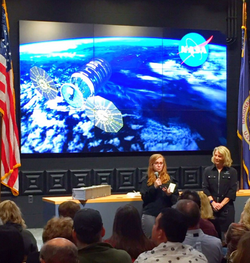 "What's On Board" NASA press conference I was fortunate enough to speak at. |
 The morning of OA-8's launch with Higher Orbits CEO and founder, Michelle Lucas. |
 Morning of OA-9's launch in front of an Antare rocket and cargo ship model. |
 Image of Space Tango's 'TangoLab' metal payload and sprouted microclovers. |
What Missions Was My Experiment Aboard?
I was fortunate enough to see my experiment flown on two different cargo resupply missions to the International Space Station.
Cygnus CRS OA-8E, launched from Wallops Island Virginia on 12 November 2017. Unfortunately no data was returned to SpaceTango's headquarters due to damage during launch
Cygnus CRS OA-9E, launched from Wallops Island Virginia on 21 May 2018.
Data was returned from this mission!
What is Higher Orbits?
Higher Orbits is a non-profit organization that hosts nationwide STEM based programs called Go For Launch! where students grades 8th-12th interact with astronauts, do hands on engaging activities but most importantly, they work in groups to design an experiment that has the chance to be conducted on the ISS.
In these troubling Covid-19 times, Higher Orbits has set up Space At Home kits to allow students to still be engaged and learn all from the safety of their home.
What was my experiment?
Experiment Constraints
-
Needs to be affected by microgravity
-
Must fit in a 10cm³ box
-
Cannot use more than 5 watts
-
Cannot contain anything dangerous
-
Must be measurable
My teammates and I came up with the idea to test the amount of nitrate put back into the soil by nitrogen-fixed plants like peanuts, alfalfa, and of course, micro-clovers. We wanted to see if nitrogen-fixed plants could possibly be used to later colonize planets by creating nutrient rich soil for other plants to grow!
Over the 30 days aboard the ISS, data was collected tracking the amount of nitrate in the environment and compared it to the control that remained on earth.
Our experiment won on the state and regional level, meaning a company called SpaceTango would work with us students to make our design and idea, into reality and we would see our little micro-clovers be launched into space.